
How to Choose the Right Air Duct Cleaning Company in Reseda
Choosing the right air duct cleaning company in Reseda comes down to three things: verifying their equipment before you book, requiring a written scope of work before they start, and picking a company that treats duct cleaning as a specialty rather than a side hustle. Most homeowners end up with a bad job because they compare quotes instead of capabilities. A $99 whole-house offer almost always means a guy with a shop vac, and that’s not duct cleaning, that’s a photo opportunity. If you’d rather skip the research and talk to someone who does this every day, call (855) 353-1653. If you want to know exactly what to ask before you call anyone, keep reading.
Ask About CFM and HEPA Before You Ask About Price
Ask any duct cleaning company you’re considering in Reseda this one question: “What CFM rating is your extraction unit, and how will you adjust for my system size?” A legitimate specialist answers it without pausing. A generalist changes the subject to their coupon. CFM (cubic feet per minute) measures how much air the vacuum unit pulls. For residential ductwork, you need at least 2,000 CFM at the point of contact to create real negative pressure that captures debris as it’s dislodged. Less than that and the dust gets stirred up and pushed into your living room instead of pulled out through the containment system.
Then ask about HEPA filtration on the exhaust side. A professional system uses HEPA-filtered vacuums that trap particles down to 0.3 microns. That’s dust mite debris, pollen fragments, and fine particulate that a standard filter just recirculates. In our experience, most Reseda homes we see have never had a proper cleaning, just a partial agitation with a consumer-grade vacuum attached to one register. The difference shows up in what the HEPA filter captures and what the homeowner breathes for the next month.
- CFM under 2,000 at the point of contact: walk away.
- No HEPA filtration mentioned: ask for the spec. No spec, no booking.
- Vague about system size: a real technician asks how many returns, how many supplies, and how many square feet before quoting.
Mechanical Agitation or Compressed Air: The Tool Question That Separates Pros from Pretenders
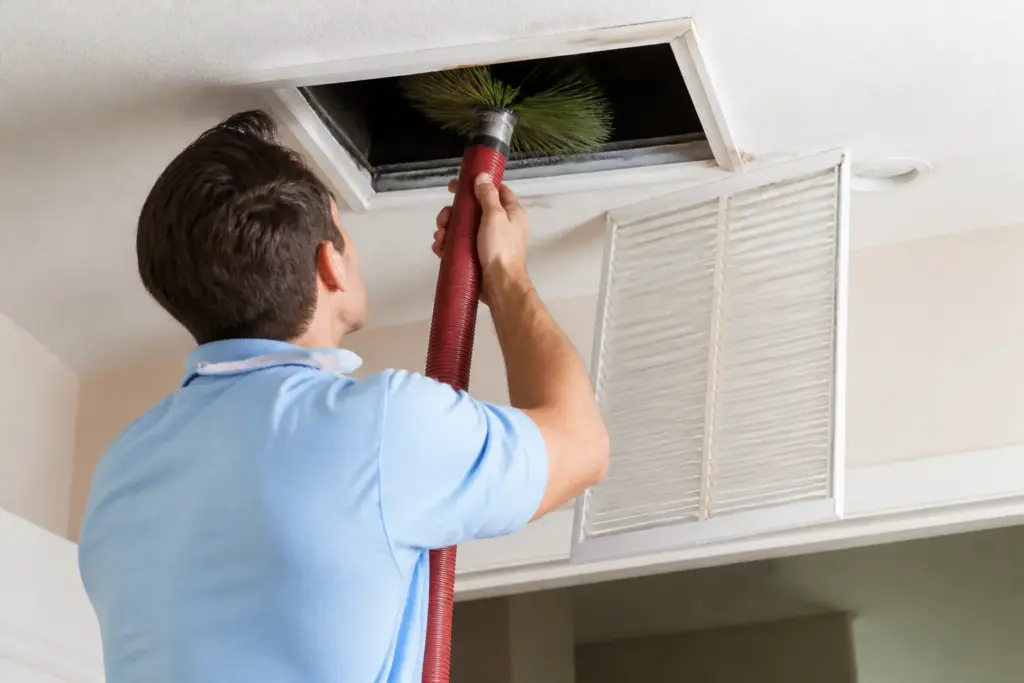
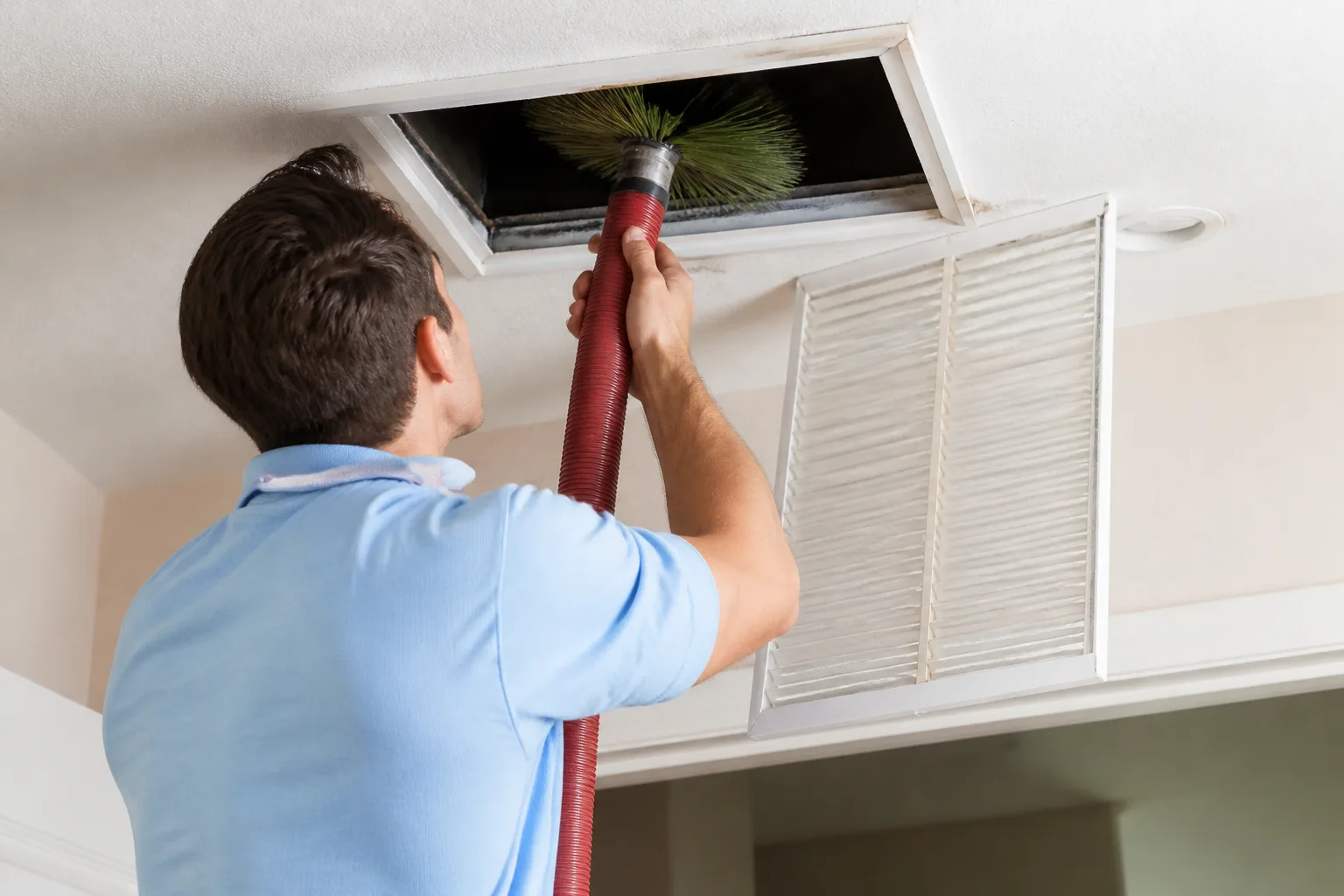
The extraction unit is half the equation. The other half is how debris gets knocked loose from the duct walls in the first place. There are two methods: mechanical agitation using a rotary brush system like Rotobrush, or compressed air blown through a whip or skipper nozzle. Both can work. Both can also fail if the operator doesn’t know what they’re doing. What matters is that the company in Reseda can explain why they use their method on your specific duct type.
Mechanical agitation with a Rotobrush-style system physically scrubs the duct interior with spinning nylon or polypropylene bristles while the vacuum runs simultaneously. That’s the industry benchmark for dislodging compacted debris, pet hair, and construction dust that’s been baked onto duct surfaces for years. Compressed air can be effective in flexible ductwork where a brush might snag, but it requires higher CFM to capture the debris it blasts loose. If a company says they use both and can tell you when each is appropriate, that’s a good sign. If they say their method is “industry standard” without naming the equipment, that’s not an answer.
One more thing worth noting: negative pressure must be established before agitation begins. If a technician turns on the brush first and the vacuum second, they’re doing it wrong. Ask about their sequence. A professional will describe it without being defensive. A generalist will look at you like you asked them to explain quantum physics.
NADCA Membership Is a Floor, Not a Ceiling
Let’s talk about NADCA, the National Air Duct Cleaners Association. Membership signals that a company has agreed to follow a set of published standards and that at least one technician has passed a certification exam. That’s genuinely useful. But it’s a starting point, not a guarantee. The exam tests baseline knowledge of airflow, contamination, and cleaning procedures. It doesn’t tell you whether the company actually owns the equipment those procedures assume, or whether the technician who passed the test is the one who shows up at your door in Reseda.
We’ve seen NADCA-member companies run jobs with undersized vacuums because the owner bought the membership for marketing purposes and rents equipment per job. The logo isn’t meaningless, but it’s not a substitute for the three equipment questions above. A serious company will tell you how long they’ve been members, who on staff holds the certification, and how their process maps to NADCA’s ACR standard for assessment, cleaning, and restoration of HVAC systems. If they can’t, the membership is decorative.
Beyond NADCA, look for any specialized training tied to the equipment they run. Rotobrush and Nikro both offer manufacturer training on their specific systems. Abatement Technologies, which makes the negative-air and containment equipment used in our industry, has rigorous protocols for preventing cross-contamination during service. A company that invests in manufacturer training is a company that treats this as a trade, not a revenue stream.
Red Flags Specific to Reseda and the San Fernando Valley
Every market has its own scams, and Reseda has a few worth knowing about. The most common one we hear about involves door-to-door solicitors who show up after wildfire season or Santa Ana wind events claiming your ducts are “full of ash.” The pitch is urgent, the price is low, and the work is rarely done. Post-wildfire particulate in ducts is a real concern, but a legitimate company doesn’t need to knock on your door to find work. If someone shows up uninvited and pressures you to book same-day, that’s not a company, that’s a hustle.
Another red flag in our market: vague “per vent” pricing without ever looking at the system. Duct systems vary wildly. A 2,500-square-foot house in Reseda might have 12 supply runs, or 18, or 22, depending on how it was built. A company that quotes per vent over the phone without asking about system configuration is essentially guessing. And per-vent pricing invites the oldest trick in the book: quoting a few vents to sound cheap, then “discovering” more during the job and billing accordingly. A real estimate comes after a visual inspection, even if that’s done by video call initially.
The third one we see often: no written scope of work before the job starts. A written scope lists exactly what’s being cleaned (supply runs, return runs, main trunk line, plenums, registers, blower motor if included), what equipment will be used, and what the final price is. If a company won’t put that in writing before they begin, walk away. The entire duct cleaning industry has a bait-and-switch reputation, and the only defense is documentation.
Reading Before/After Photos Critically: What Contractors Don’t Want You to Know
Before/after photos are the most manipulated marketing asset in our industry, and Reseda homeowners deserve to know how to read them. A marginally cleaned duct can look transformed with the right camera work, and a genuinely clean duct can look underwhelming with bad lighting. Here’s what to actually compare between the two photos:
- Camera position: is the before photo taken at a different angle than the after? A before shot from directly in front of a duct wall showing caked-on debris, followed by an after shot from an angle that catches shine rather than surface condition, isn’t a comparison. It’s a lighting trick.
- Lighting conditions: before photos are often taken with a flash that creates harsh shadows and makes debris look thicker. After photos get soft or diffused light. Same register in both, same lighting setup, or the comparison is meaningless.
- Focus depth: a before photo with the camera focus pulled close to a debris pocket and an after photo with a deep focus that makes the entire duct look smooth isn’t apples to apples. Look for photos taken at the same register, with the same field of view.
- What’s actually visible: a decent camera can only see the first few feet of a duct run from a register. Any photo claiming to show a “deep clean” of a 30-foot run isn’t showing you the run, it’s showing you the first bend. Ask how they document runs beyond visual range. A professional can show camera-scope footage from inside the duct, not just register-level photos.
None of this means before/after photos are worthless. It means they’re evidence, not proof. A company that offers full scope footage and lets you inspect specific registers after the job is giving you verifiable proof. A company that hands you a brochure photo and calls it done is testing whether you’ll actually look.
Specialists vs. Generalists: Why the Number of Services Tells You Something
There’s a structural difference between a company that does air duct cleaning as one of twelve services and a company where it’s the entire business. That difference shows up in training depth, equipment investment, and what happens when something goes wrong mid-job. A 12-service HVAC company sends a tech who does three ducts this week, two water heaters next week, and a furnace install the week after. Their depth in any single trade is necessarily limited, and their duct cleaning equipment is probably the minimum viable setup.
In our work around Reseda, we regularly see jobs where a generalist “cleaned” the accessible portions of ductwork, skipped the main trunk line entirely, and never noticed that a return run was collapsed or disconnected because they weren’t looking for it. A specialist who does ducts every day is looking for exactly that, because they’ve seen it hundreds of times. That’s the difference: pattern recognition built on repetition. The cleaning itself matters, but finding compromised ductwork during the process is the part that saves money.
And here’s the structural point: when a company is built around air duct cleaning, with air duct repair in Reseda as a core service rather than an afterthought, they can actually fix what they find. A generalist has to refer it out, which means another estimate, another visit, another week. A specialist who finds a crushed return while cleaning can often repair it in the same visit. That’s the “we clean, then we repair” model, and it’s only possible when repair is a real part of the business, not a phone number passed along.
If you’re just starting your search, start with our Air Duct Cleaning Reseda home page to see the full scope of what we do, or check out the specifics of Air Duct Cleaning in Reseda if you want a deep dive into the process.
What happens when you call
- 1
A real person answersNo phone trees – you reach a local pro.
- 2
You get an upfront price rangeHonest numbers before anyone is dispatched.
- 3
A background-checked tech heads outLicensed & insured, dispatched right away.
- 4
You approve before work beginsNothing starts until you say go.
What a Legitimate Estimate Looks Like in Reseda
By this point, you know the equipment questions, the red flags, and how to read the marketing materials. But what does a legitimate estimate actually look like when you call one of these companies in Reseda? It looks like a conversation, not a price. A real estimate starts with questions about your home: square footage, number of registers, how many returns, when the system was last cleaned, whether you’ve had renovations, pets, smokers, or wildfire smoke exposure. Then it involves a look at the system, either in person or through a video walkthrough where you show the technician the furnace, the return, and a few registers.
Only after that does a real company give you a number. And the number is a whole-system price, not a per-vent teaser. For a typical single-family home in Reseda, a full air duct cleaning with mechanical agitation and HEPA extraction generally runs between $450 and $900 depending on system size and contamination level. Additional services like dryer vent cleaning in Reseda are quoted separately and clearly, not buried in the fine print. If you get a $99 quote based on nothing but “how many vents?” treat it as the sales pitch it is.
A written estimate should include the scope, the equipment being used, the expected duration, and the final price. No asterisks. No “additional fees discovered on site.” If the technician finds something unexpected mid-job, like a dead rodent in a duct run or a disconnected return, they should call you with photos and a clear additional scope before doing anything. That’s process transparency, and it’s the difference between a company that respects you and a company that’s trying to upsell you.
The Bottom Line
Choosing the right air duct cleaning company in Reseda isn’t about finding the cheapest quote or the best-reviewed ads. It’s about verifying equipment, demanding process transparency, and hiring a specialist who can explain what they’re doing in specific terms. Ask about CFM. Ask about HEPA. Ask about their agitation method and their containment sequence. Require a written scope before work begins. Read before/after photos with the same scrutiny you’d apply to a used-car listing. And remember that a duct cleaning company that also repairs ductwork is structurally different from one that cleans and walks away. If you’re in Reseda and need help, Air Duct Cleaning Reseda offers free estimates with a written scope. Call (855) 353-1653 and ask us the CFM question. We’ll answer it.
Frequently Asked Questions
For a typical single-family home in Reseda, expect $450 to $900 for a full system cleaning with mechanical agitation and HEPA-filtered extraction. Smaller homes or lightly used systems may fall under that range, while heavily contaminated systems with years of buildup, pet hair, or post-renovation dust can run higher. Any quote under $200 for a whole house should be treated as a red flag. Call (855) 353-1653 for an exact quote based on your system.
Most homes in Reseda need duct cleaning every 3 to 5 years, but that varies based on pets, smoking in the home, recent renovations, and wildfire exposure. If you can see dust accumulating around your registers within days of cleaning, or if your allergies flare up specifically at home, your ducts may be overdue. Have a technician inspect before deciding either way. A good company will tell you if you don’t need the service yet.
Cheaper quotes usually mean weaker equipment and shorter job times. A $99 cleaning typically uses a consumer-grade vacuum that can’t generate the CFM needed for real extraction, skips the main trunk line, and finishes in under an hour. Proper mechanical agitation with Rotobrush-style brushes and HEPA extraction on a full system takes several hours. You’re paying for the equipment, the time, and the fact that the job will actually be done. Call (855) 353-1653 if you want an honest breakdown of our pricing.
Ask for camera-scope footage from inside the duct runs, not just register-level photos. Ask to inspect specific registers after the job. A legitimate company will show you what came out of the system and what the duct walls look like after cleaning. If the company refuses or only offers a “trust us” answer, that’s your sign. A real professional has nothing to hide and the documentation to prove it.
Written by the team at Air Duct Cleaning Reseda, serving Reseda since 2011.
Need Air Duct Cleaning Help?
Call Air Duct Cleaning Reseda - licensed & insured, with free written estimates in Reseda.
(855) 353-1653